
Establishing a Carbon Neutral Society
To establish a carbon-neutral society, Toyota Industries has set the prevention of global warming as our highest priority issue and seeks to reduce emissions during product use and energy usage in the business activities of all sites and to minimize CO2 emissions throughout the entire value chain.
Our Approach
For Toyota Industries, dealing with global warming is not just a “risk.” It also presents “opportunities” in doing business to both differentiate ourselves by leveraging our technology-based product appeal and conduct eco-conscious production activities. For the ultimate goal of establishing a carbon neutral society as stated in our Global Environment Commitment, we set a goal of establishing a zero CO2 emissions society on a global basis in our Environmental Vision 2050 and have been making efforts to reduce greenhouse gas (GHG) emissions throughout our entire supply chain. In the area of product development, we have been promoting the development of technologies related to environmentally friendly products in various fields, including electrification. In production activities, promoting thorough energy savings and utilizing renewable energy and hydrogen are the two pillars of our activities. As specific efforts, we will adopt solar and other renewable energy sources and effectively utilize clean energy, such as hydrogen, while thoroughly eliminating wasteful use of energy in production processes and increasing the efficient use of energy.
Endorsement of the TCFD Recommendations
Toyota Industries announced its endorsement of the TCFD* recommendations in December 2019. We see climate-change related risks and opportunities as a crucial management issue and take action with climate change as one of our CSR material issues. In November 2021, we conducted scenario analysis in the materials handling equipment business and disclosed information relating to governance, strategies, risk management, metrics and targets, which are the disclosure items recommended by the TCFD.
* The Task Force on Climate-related Financial Disclosures. The task force was established in 2015 pursuant to a request from the G20 to investigate climate-related disclosure by the Financial Stability Board and how financial institutions should respond.
<Governance>
The Environmental Committee is chaired by the President. The committee deliberates and investigates important matters related to the promotion of environmental management. Such matters include formulation of mid- and long-term targets for key management indicators related to climate change, such as the achievement of CO2 emissions targets, progress management, and investments related to energy conservation.
<Strategy>
To identify the impacts that climate change risks and opportunities will have on the Company, we conducted scenario analysis in the materials handling equipment business, one of our core businesses. The time frames were set at 2030 and 2050, the years adopted in the medium-term business strategy and long-term environmental vision. The scenarios adopted were the below 2°C scenario, under which the Company will be exposed to transition risks, and the 4°C scenario, under which the Company will it be exposed to physical risks. When performing the analysis, we made reference to the future scenarios relating to representative concentration pathways (RCP 2.6 and 8.5 scenarios) in the Fifth Assessment Report of the Intergovernmental Panel on Climate Change (IPCC) as well as the Sustainable Development Scenario (SDS) and the Stated Policies Scenario (STEPS) in the World Energy Outlook of the International Energy Agency (IEA).
Assumed Analysis Scenario Conditions
| Analysis conditions | |
|---|---|
| Business | Materials Handling Equipment |
| Scope | Value chain |
| Time frames | 2030 and 2050 |
| Scenarios | Below 2°C scenario and 4°C scenario |
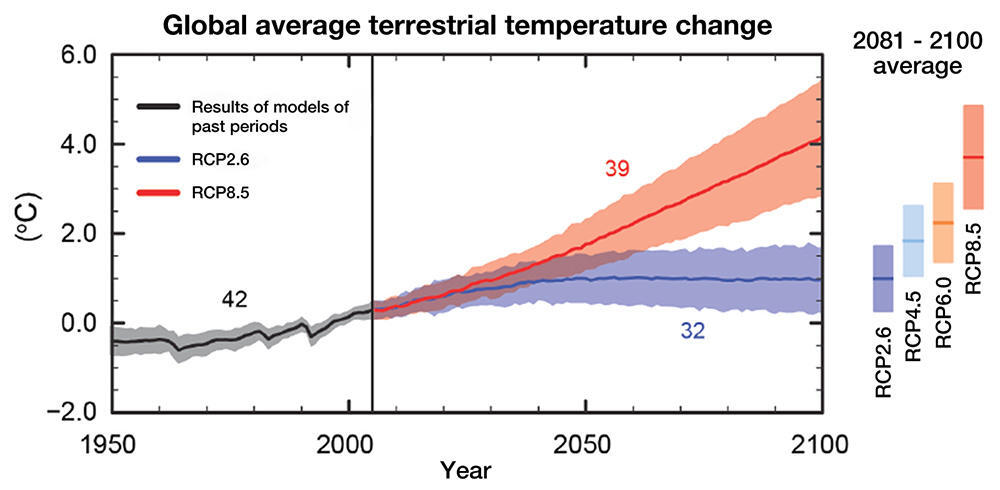
Source: Japan Meteorological Agency, Climate Change 2013, Natural Science Basis, Summary for Policymakers
Image of the Company’s social conditions under each scenario
| Below 2°C scenario | 4°C scenario | |
|---|---|---|
| Market | ・Increase in logistics and transportation volume, decentralization of logistics facilities ・Market expansion for warehouse automation, Automated Guided Vehicles (AGVs), and Autonomous Mobile Robots (AMRs) |
|
| ・Increase in demand for electric and fuel cell lift Trucks | Impact of 4°C scenario is slower than for below 2°C scenario | |
| Policy and regulatory | ・Increase in operating and procurement costs due to introduction of carbon tax ・Introduction of new regulations to mitigate climate change ・Strengthened existing regulations |
|
| Reputation | ・Strengthened disclosure requirements for climate change-related information ・ESG investment expansion |
|
| Physical environment | Impact of below 2°C scenario is slower than for 4°C scenario | ・Chronic temperature increase ・Increased frequency of flooding ・Sea level rise |
We identified the business risks and opportunities under the above scenarios that would have a significant impact on our business. We then identified, for example, the risk of sales decreasing due to stricter regulations concerning climate change mitigation and opportunities to increase sales as a result of higher demand for products with outstanding environmental performance, set these as targets for CSR material issues, and incorporated them into our business strategies.
Assessment of financial impacts through scenario analysis
| Risks and Opportunities Relating to Climate Change over the Short, Medium, and Long-Term | ||
|---|---|---|
| Risks | Transition risks (Below 2°C) |
|
| ・Increase in operating costs due to the introduction of carbon tax | ||
| ・Increase in procurement costs for materials and parts due to carbon tax price shifting | ||
| ・Decline in sales due to lower demand for internal combustion engine vehicles as a result of new regulations and tighter existing regulations to mitigate climate change | ||
| ・Decline in stock price in case investors deemed our climate-related disclosure reluctant | ||
| Physical risks (4°C) | ・Decline in sales due to the suspension of operations of suppliers and damage to logistics functions caused by natural disasters (flooding due to heavy rain, etc.) | |
| Opportunities | ||
| ・Sales increase due to growing demand for products with superior environmental performance (Electrification, hydrogen fuel, and biofuel vehicles, etc.) |
||
| ・Sales increase accompanying increased number of small distribution warehouses due to decentralization of distribution bases to build a disaster-resilient distribution system | ||
| ・Sales increase of automation products thanks to unmanned distribution warehouses to reduce CO2 emissions from lighting and air conditioning | ||
Responses to Risks and Opportunities
| Responses to Risks and Opportunities | |
|---|---|
| Production | ・Reduce CO2 emissions from production activities ・Promote the efficient adoption of renewable energy ・Demonstrative introduction of hydrogen facilities ・Contribute to hydrogen supply chain establishment |
| Products | ・Develop new technologies and products that help in resolving environmental and social issues ・Develop new technologies and products for logistics automation and expand sales ・Expand sales of electrification-related products ・Provide clean, high-quality fuel cell units and on- board batteries |
| Disclosure | ・Enhance disclosure, strengthen communication ・Global standard GHG calculations ・Obtain third-party certification |
<Risk Management>
Climate-related risks have been expressly defined as one of the Company’s CSR material issues and are managed under company-wide risk management structures. We set clear management metrics and targets in order to mitigate the impacts of climate-related risks, and Environmental Committee, which is chaired by the President, performs periodic monitoring.
<Indicators and Targets>
In order to mitigate risk and expand opportunities posed by climate change, we have set medium- to long-term targets for products and production.
Targets
With regard to Scope 1 and 2 emissions, we will improve production and operating processes, introduce high-efficiency, energy-saving equipment, electrified production processes, and switch fuels to hydrogen and other forms of clean energy. With regard to Scope 3, we will reduce CO2 emissions by electrifying products, raising their efficiency, and making them lighter, increasing loading efficiency and transport efficiency and logistics, and taking other measures.
| CO2 emissions in out production activities | Scope1 | Direct emissions of greenhouse gas emissions by a business operator (combustion of fuel, industrial processes) |
|---|---|---|
| Scope2 | Indirect emissions in conjunction with the use of electricity, heat, and steam supplied by other companies | |
| CO2 emissions outside of our production activities | Scope3 | Indirect emissions other than Scope 1, 2 (emissions of other companies related to the business operator’s activities) For example, emissions generated in the use and disposal stages of the Company’s products |
<Production>
| Target year | CO2 emissions | Renewable energy ratio | |
|---|---|---|---|
| Targets | FY2026 | Down 25% from FY2014 | 15% |
| FY2031 | Down 50% from FY2014 | - | |
| 2050 | 0 | - |
Note: Some basis year, emissions factors, and other items have been revised from the Seventh Environmental Action Plan
<Product>
| Target year | CO2 emissions | |
|---|---|---|
| Targets | FY2026 | - |
| FY2031 | - | |
| 2050 | CN |
Activity Results
Scope 1, 2
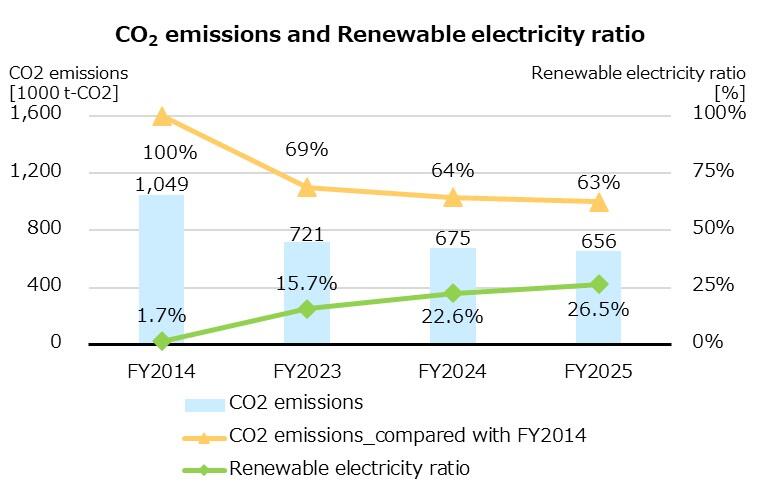
Under the Seventh Environmental Action Plan, we are working to reduce CO2 emissions from production process by 25% from the fiscal 2014 level by fiscal 2026. In fiscal 2025, we were able to achieve our goals through a range of CO2 reduction activities. These included electrification of equipment, energy savings through changes in production order, and proactive introduction of renewable energy.
*The figures in this graph differ from those in the data library because it uses the scope and coefficients suitable for target management in some locations.
Scope 1, 2, 3
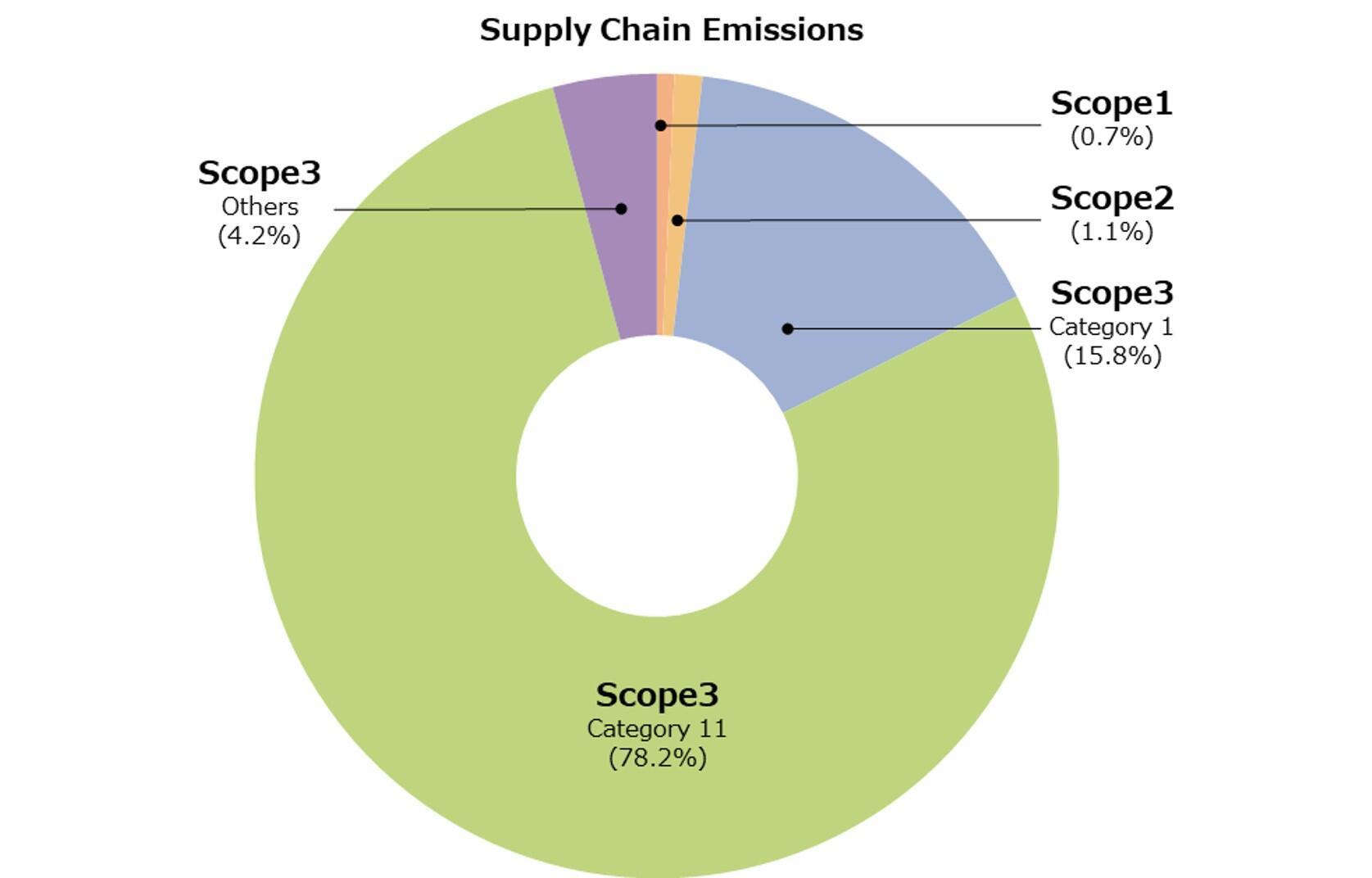
Fiscal 2025 results were as follows. Scope 1 and 2 emissions accounted for 1.8% of the total, while Scope 3 emissions accounted for 98.2% of the total. The area with the highest emissions was Category 11 (emissions from use of sold products) of Scope 3, accounting for 78.2% of total Scope 3 emissions.
Examples
Toyota Industries Report 2025 p43-44
Product: Contributing to Solving Social Issues through Business
Toyota Industries Report 2025 p49
Production: Reducing CO2 Emissions by Eliminating High-Pressure Air Systems